Published in Pjama Healthcare
Alarm therapy is an evidence-based first-line treatment for nocturnal enuresis.
Yet despite its documented efficacy, one challenge remains persistent across clinical settings:
Adherence.
The success of alarm therapy depends not only on the method itself, but on how consistently it is used over time — often in demanding circumstances for families.
Increasingly, evidence and clinical experience point to the same conclusion: when families are actively supported and engaged, treatment outcomes improve.
Adherence: the hidden determinant of success
From a clinical perspective, non-response to alarm therapy is not always a question of inefficacy. In many cases, it reflects incomplete adherence.
Families are asked to:
- wake during the night
- assist the child consistently
- continue treatment for weeks or months
- manage sleep disruption alongside daily life
Without adequate support, motivation often declines — even when treatment could have been effective if completed.
Why family involvement matters
Families are not passive recipients of enuresis treatment.
They are active participants in every night of therapy.
Research shows that:
- adherence drops early when families feel unsupported
- lack of feedback increases uncertainty and frustration
- unclear expectations reduce persistence
- perceived failure is often internalised by families, not by the method
Conversely, when families understand the treatment rationale, feel guided, and receive feedback, adherence improves — and so do outcomes.
Support does not have to mean more clinic visits
Traditional support models rely heavily on in-person follow-up and direct healthcare contact. While valuable, these approaches can be resource-intensive and difficult to sustain.
Recent studies suggest that structured, continuous support — even when delivered digitally — can make a meaningful difference.
Key elements of effective family support include:
- clear instructions aligned with guidelines
- realistic expectations about timelines and effort
- early feedback on progress
- reassurance during difficult phases
- a sense that someone is “following along”
The form of support matters less than its consistency and clarity.
The link between support, data and motivation
When families can see how treatment is progressing, uncertainty decreases.
Structured monitoring and feedback can:
- make small improvements visible
- validate the family’s effort
- reduce premature discontinuation
- support informed conversations with clinicians
Importantly, this shifts the narrative from “trying hard” to “working together with a plan.”
Clinical implications: shared responsibility improves care
When families are recognised as part of the care team, several clinical benefits emerge:
- improved adherence without increased clinic workload
- earlier identification of difficulties
- more meaningful follow-up conversations
- reduced blame placed on the child or caregivers
This shared approach aligns well with modern, patient-centred care models — particularly in chronic or behaviourally demanding treatments.
Digital tools as enablers, not replacements
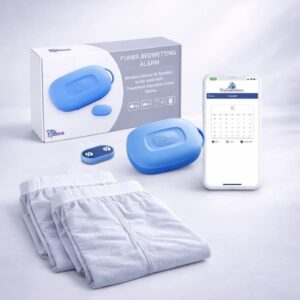
Digital support tools can facilitate family involvement by:
- providing daily guidance
- supporting consistent routines
- visualising progress over time
- enabling timely reassessment
Crucially, these tools do not replace clinical judgement or human care.
They extend the clinician’s reach into the everyday context where treatment actually happens.
Conclusion: adherence improves when families are not left alone
Alarm therapy does not fail in isolation.
It succeeds — or struggles — within the realities of family life.
By recognising families as active members of the care team, and by providing structured, ongoing support, clinicians can:
- improve adherence
- reduce unnecessary treatment burden
- support better outcomes for children with enuresis
Effective enuresis care happens not only in the clinic, but every night at home.
When families are supported, treatment has a better chance to succeed.
References
Larsson J, Borgström M, Karanikas B, Nevéus T. Can enuresis alarm therapy be managed by families without nurse support? Acta Paediatr. 2022.
Larsson J et al. Predictors of response and adherence to enuresis alarm therapy. J Pediatr Urol. 2023.
Nevéus T et al. Evaluation and treatment of nocturnal enuresis: ICCS standardization document. J Urol. 2010.
Glazener CM, Evans JH. Alarm interventions for nocturnal enuresis in children. Cochrane Database Syst Rev. 2005.
Franco I et al. Pediatric Incontinence: Evaluation and Clinical Management. Wiley Blackwell, 2015.