
Published in Pjama Healthcare
How early treatment data can support better clinical judgement in enuresis care
Alarm therapy remains a central part of evidence-based enuresis treatment.
Yet in everyday clinical practice, the challenge is rarely whether alarm therapy works — but how to know when to continue, adjust, or stop.
As shown by recent research, early treatment response provides valuable prognostic information. The next question for healthcare professionals is therefore practical:
How do we turn early treatment data into meaningful clinical decisions?
The challenge: information without structure
Families are often asked to keep diaries or track wet and dry nights during treatment. While this information is valuable, it can be difficult to interpret consistently.
In busy clinical settings, challenges include:
- incomplete or irregular data
- delayed follow-up
- uncertainty about how much change is “enough”
- variation in how clinicians interpret early progress
Without structure, data risks becoming descriptive rather than decision-supportive.
Why early data matters only if it is used
Early response data is most valuable when it informs action.
Research shows that patterns emerging during the first weeks of alarm therapy can help clinicians:
- identify likely responders
- recognise low probability of success early
- guide conversations with families
- avoid unnecessary prolongation of ineffective treatment
However, this requires that data is:
- collected consistently
- reviewed systematically
- discussed transparently with families
Data alone does not improve care. Decisions do.
From observation to clinical guidance
A structured approach to early treatment data supports clinical judgement rather than replacing it.
In practice, this means:
- defining time points for evaluation (e.g. after 3–4 weeks)
- agreeing on what constitutes meaningful improvement
- documenting trends rather than isolated events
- using data as a basis for shared decision-making
Such structure helps clinicians move away from passive monitoring towards active, responsive care.
Supporting families through clarity
For families, uncertainty is often more burdensome than treatment itself.
When early data is reviewed and discussed clearly, families gain:
- realistic expectations
- reassurance that progress is being evaluated
- understanding of why a treatment is continued or paused
This clarity can improve trust, reduce frustration, and support adherence when treatment is ongoing.
Importantly, data-informed decisions help avoid placing the emotional responsibility for “success” or “failure” on the child or family.
The role of digital decision support
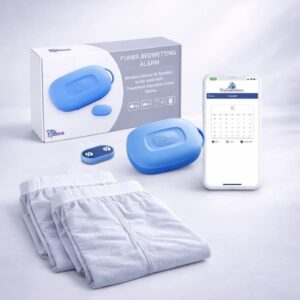
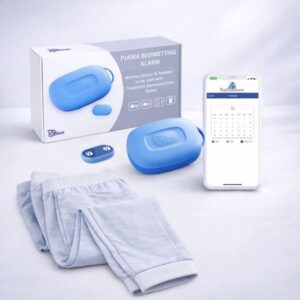
Digital tools can help translate early treatment data into clinically useful insights by:
- enabling daily, reliable registration
- visualising trends over time
- highlighting response patterns
- supporting timely follow-up
When integrated thoughtfully, digital support does not replace clinical judgement — it strengthens it, by making relevant information visible at the right time.
The goal is not more data, but better decisions.
Clinical judgement remains central
Every child with enuresis presents a unique combination of biological, psychological and contextual factors. No algorithm or dataset can replace professional assessment.
What structured data can do is:
- reduce uncertainty
- support consistency
- provide a shared reference point between clinician and family
Used in this way, early treatment data becomes a tool for better care — not an administrative burden.
Moving forward: clarity over endurance
Effective enuresis care is not defined by how long a treatment is maintained, but by how well it is guided.
By combining early response data with clinical experience, healthcare professionals can:
- individualise treatment pathways
- allocate resources more effectively
- support families with confidence and transparency
From data to decisions — this is where evidence-based care becomes lived clinical practice.
References
Larsson J, Borgström M, Karanikas B, Nevéus T. The value of case history and early treatment data as predictors of enuresis alarm therapy response. J Pediatr Urol. 2023.
Nevéus T et al. Evaluation and treatment for monosymptomatic enuresis: ICCS standardization document. J Urol. 2010.
Franco I et al. Pediatric Incontinence: Evaluation and Clinical Management. Wiley Blackwell, 2015.
Glazener CM, Evans JH. Alarm interventions for nocturnal enuresis in children. Cochrane Database Syst Rev. 2005.