
Early response as a predictor of treatment success in enuresis
Alarm therapy is widely recognised as a first-line treatment for nocturnal enuresis.
Its effectiveness is well documented, and it remains a cornerstone of non-pharmacological care.
At the same time, clinicians are familiar with the challenges that follow once treatment has started. Alarm therapy can be demanding for families, resource-intensive for healthcare services, and difficult to evaluate in real time.
One question returns again and again in clinical practice:
How long should we continue alarm treatment before we know whether it is working?
The traditional approach – and its limitations
Historically, alarm therapy has often been evaluated after six to eight weeks. This timeframe has become part of clinical routine, shaped by early studies and long-standing practice.
However, this approach has clear limitations.
For families, prolonged treatment without visible improvement can lead to frustration, fatigue, and reduced motivation.
For clinicians, it can create uncertainty around when to encourage persistence and when to reconsider the treatment strategy.
Waiting longer does not always mean learning more. The critical question is not how long treatment lasts, but what happens early on.
What the evidence tells us about early response
A growing body of research shows that the first three to four weeks of alarm therapy carry strong prognostic value.
Multiple studies have demonstrated that:
- A reduction in wet nights during the early phase of treatment strongly predicts long-term success.
- Children who show little or no improvement after the first weeks have a significantly lower likelihood of achieving dryness later on.
- This predictive value remains even when accounting for factors such as daytime incontinence or family circumstances.
In other words, early response is not merely encouraging — it is informative.
Rather than being a preliminary phase to “get through,” the initial weeks of treatment provide actionable clinical insight.
Clinical implications: when structure matters more than endurance
Recognising the importance of early response changes how alarm therapy can be managed in practice.
Early follow-up allows clinicians to:
- identify non-responders sooner
- adjust expectations with families
- reconsider treatment timing or approach
- reduce unnecessary burden on the child and caregivers
Importantly, choosing to pause or stop a treatment that shows no early effect is not a failure. In many cases, it represents better, more individualised care.
A structured approach to early evaluation supports clinical decision-making and helps move away from passive “wait and see” strategies.
The family perspective – clarity builds trust
For families, the first weeks of alarm therapy are often the most challenging. Sleep disruption, emotional strain, and uncertainty are common.
Clear communication about what to expect — and when treatment effects should be visible — helps families feel supported and understood.
When clinicians base decisions on early, observable patterns rather than prolonged uncertainty, it:
- strengthens trust
- reduces feelings of guilt or failure
- supports adherence when treatment is continued
- validates the family’s experience
Early evaluation is therefore not only clinically sound, but also ethically and relationally important.
The role of structured and digital follow-up
Identifying early response requires reliable data and consistent monitoring.
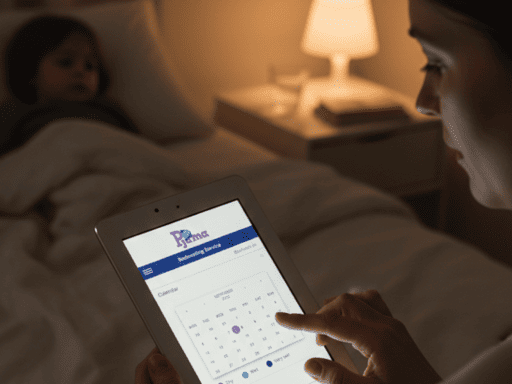
Digital tools can support this process by:
- facilitating daily registration
- making treatment patterns visible
- supporting shared decision-making between families and healthcare providers
The value lies not in the technology itself, but in enabling timely, informed clinical decisions that align with each child’s situation.
Rethinking alarm therapy – not if, but when
Alarm therapy remains an effective and evidence-based treatment for enuresis.
But its success depends on the right timing, the right expectations, and the right follow-up.
Four weeks can be enough to determine direction.
Four weeks can reduce uncertainty.
Four weeks can improve care.
Early response does not only predict outcome —
it helps clinicians provide better, more responsive treatment.
References
Nevéus T et al. Evaluation and treatment for monosymptomatic enuresis: a standardization document from the International Children’s Continence Society (ICCS). J Urol. 2010.
Glazener CM, Evans JH. Alarm interventions for nocturnal enuresis in children. Cochrane Database Syst Rev. 2005.
Larsson J, Borgström M, Karanikas B, Nevéus T. The value of case history and early treatment data as predictors of enuresis alarm therapy response. J Pediatr Urol. 2023.
Nevéus T, Eggert P. Predictors of response and adherence to enuresis alarm therapy. J Pediatr Urol.
Franco I et al. Pediatric Incontinence: Evaluation and Clinical Management. Wiley Blackwell, 2015.